Intent-Based Merchandising and the AI Agent Advantage


Intent-based merchandising uses behavioral signals, beyond the words a shopper types, to decide which products to surface and in what order. It applies intent-based marketing to product discovery, and that same intent data now decides whether an AI shopping agent recommends your catalog or skips it.
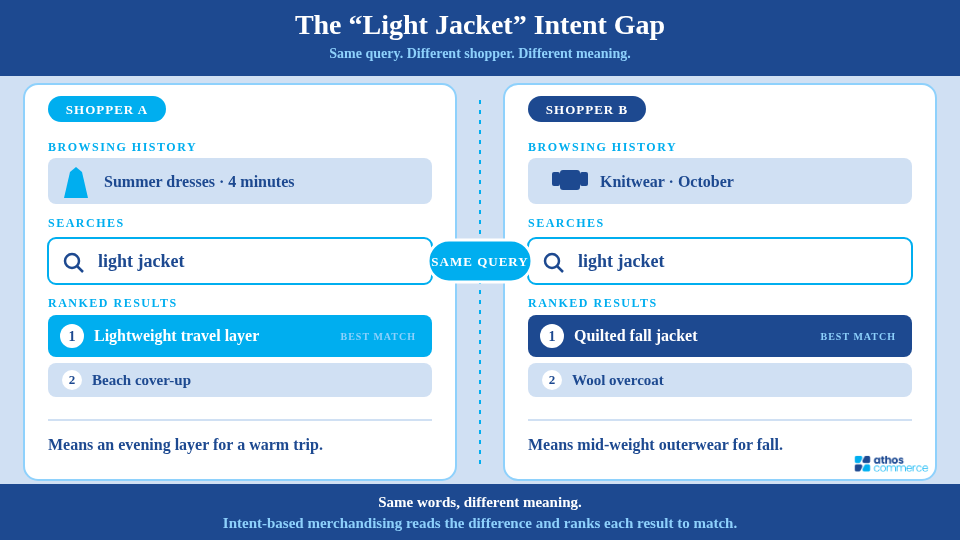
A shopper types “light jacket,” the results populate, and the shopper leaves. The catalog held the right product, yet the system missed that this person had spent four minutes browsing summer dresses first. “Light jacket” meant an evening layer for a warm-weather trip, not fall outerwear, and that gap never appeared in a keyword report. Ecommerce teams have spent years improving what happens after a query fires. Reading what a query means is the harder problem. It decides conversion today and AI agent visibility tomorrow.
What Is Intent-Based Merchandising?
Intent-based merchandising uses behavioral signals alongside the literal search term to decide which products to surface and in what order. Those signals include browsing history, in-session click patterns, time of year, and device type. The words stay the same. The meaning behind them shifts with context. This is intent-based marketing applied to product discovery, ranking results around purchase intent rather than keyword matches alone.
Why Do Keywords Miss Shopper Intent?
Keywords are a proxy for intent, not intent itself. “Running shoes” in January signals a New Year fitness buyer. The same query in September signals a back-to-school athlete. A keyword system serves both shoppers the same products. “Gift for dad” maps to no clean category, so the system defaults to bestsellers that may miss the occasion or the budget. Rule-based merchandising makes this worse. The long tail of real shopper language runs wider than any rules library can cover, and a boost rule written three months ago can fight what a shopper needs today. Every near-miss reads as a bounce in standard analytics, which treats the search as resolved and hides the lost revenue.
How Does Intent-Based Merchandising Work?
Intent-based merchandising updates ranking logic in real time based on what the current session communicates. Two shoppers can type the same query and receive different ranked results, each calibrated to purchase intent. This is how behavioral data turns a flat keyword match into an accurate recommendation.
What Behavioral Signals Drive Better Results?
The strongest intent signals come from what a shopper does, not only what they type. A shopper who browses summer dresses for four minutes and then searches “cover-up” wants a lightweight warm-weather layer. The same query from a shopper browsing knitwear in October means something different in category and weight. An intent-aware system reads that context and ranks products accordingly. Artificial intelligence handles this at a scale and speed no manual rule set can reach.
How Is Intent Data Different From Personalization?
Personalization identifies who the shopper is, often by showing last-viewed items. That helps, yet it does not resolve intent on its own. Intent-based marketing reads what the live session communicates and adjusts ranking in the moment. Past behavior tells the platform who the shopper is. Session data supplies what they need right now. A platform that reads both produces sharper results than one reading either input alone.
Do Merchandising Teams Stay In Control?
Merchandising teams stay fully in control. Intent-aware systems and manual control operate at different layers, which means a marketing team keeps the ability to run marketing campaigns, set promotional priorities, and hold brand standards while AI adjusts results in real time. Merchandisers define the guardrails. The platform applies intent signals inside them.
“We’re amazed to see how much revenue can be driven by search. Even though about 90% of our shoppers prefer to browse our categories, almost half our revenue now comes from search.”
Romane Vernet, Senior Designer / Developer, Metro Kitchen
Where Does The Revenue Come From?
The revenue follows the accuracy. Michael Stars saw a 951 percent increase in revenue per visit after adopting AI-powered product discovery with Athos Commerce. That result ran on intent-aware systems working at a scale manual rules cannot match, inside guardrails the merchandising team defined. Efficiency follows too. Early Settler cut weekly merchandising work from up to 15 hours to three to five hours after adopting automated rules, and lifted its conversion rate 10 to 15 percent on in-stock products. Better results and less manual work arrive together.
Why Does Intent Data Matter For AI Shopping Agents?
AI shopping agents use the same intent data that powers on-site discovery. This is where intent-based marketing stops being a conversion tactic and becomes infrastructure for the next channel.
How Do AI Agents Choose Products?
An agent handling “trail running shoes under $120” does not browse, filter, or compare the way a person does. It queries structured product data and picks the merchant whose catalog best matches the request, its constraints, and the buyer intent behind it. Merchants with rich behavioral and intent signals win those evaluations. Keyword-only catalogs get passed over, because sparse data reads as poor catalog quality to an evaluating agent. The market is arriving fast. Morgan Stanley estimates agentic shoppers could drive up to base $385 billion in U.S. ecommerce by 2030, or 10 to 20 percent of total online spend.
“Agentic will be a paradigm shift for e-commerce.”
Nathan Feather, Morgan Stanley Research
Behavioral data compounds. A retailer that refines intent signals month over month builds an asset competitors cannot reconstruct after the fact. The retailers who wait will fall behind by years of behavior they never collected.
Where Should You Start?
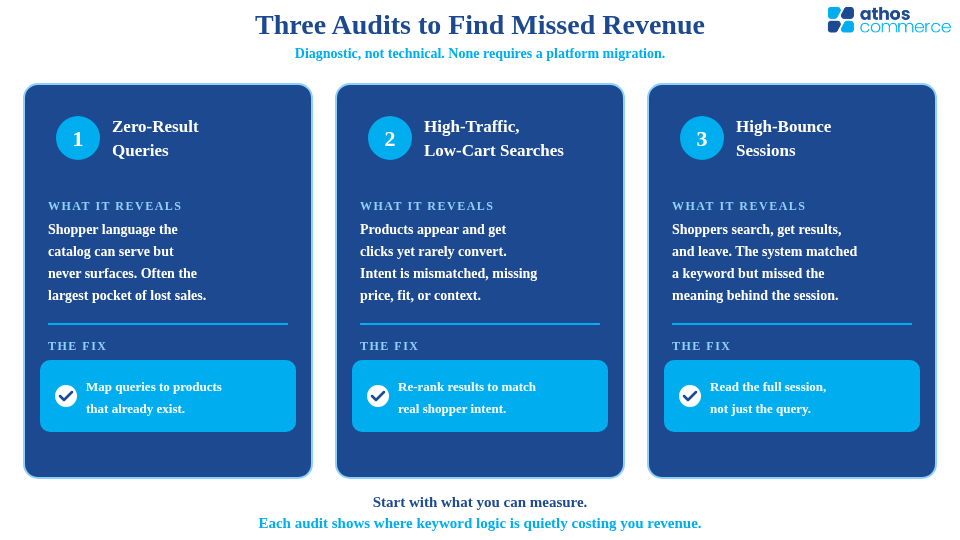
For most teams, the barrier is diagnostic, not technical. Three audits surface the largest opportunities, and none requires a platform migration.
| Audit | What it reveals |
| Zero-result queries | Shopper language the catalog can serve but never surfaces. This is often the single largest pocket of missed revenue. |
| High-traffic, low-add-to-cart searches | Intent mismatch at the result level, where products appear but miss the price, fit, or context the shopper carried in. |
| High-bounce sessions after a search | Sessions where the system matched a keyword but missed the meaning behind the browsing that preceded it. |
Athos Commerce: Intent-Based Merchandising For Product Discovery
Intent-based merchandising turns behavioral signals into revenue today and AI agent visibility tomorrow. An intent-based marketing strategy built on this data gives retailers who start now a lead measured in years of shopper behavior their competitors never captured.
Athos Commerce built its Intelligent Discovery Platform for exactly this work, combining search, merchandising, and personalization on one AI and one product data layer. The platform reads customer intent in real time, keeps merchandising teams in control of promotions and brand standards, and syndicates clean product data across 1,400+ channels, including AI tools like ChatGPT and Gemini. Every improvement to your catalog teaches every surface at once.
Book a demo with Athos Commerce to find where your store is missing intent signals and build a discovery experience that serves shoppers and AI agents alike.
Frequently Asked Questions
What Is Intent-Based Merchandising?
Intent-based merchandising uses behavioral signals alongside a search query to decide which products to surface and in what order. It applies intent-based marketing to product discovery. Unlike keyword systems that return the same products to everyone, it calibrates results to what the current session communicates.
What Is Intent-Based Marketing?
Intent-based marketing uses behavioral signals, such as browsing history and in-session clicks, alongside the search term to predict what a shopper wants. It ranks results around purchase intent rather than keywords alone. In ecommerce, intent-based merchandising is how that approach reaches the product page.
What Are Intent Signals?
Intent signals are behavioral inputs that reveal what a shopper means. They include browsing history, click patterns in the current session, time of year, and device type. None of these change the words a shopper types, yet they change the meaning of the query.
How Do AI Shopping Agents Use Intent Data?
AI shopping agents query structured product data to match a request to the best merchant. Retailers with rich behavioral and intent data give agents clearer signals of catalog quality and relevance. That improves the odds their products get recommended over keyword-only catalogs.
What Is The Difference Between Intent-Based Marketing And Personalization?
Personalization identifies who a shopper is, often by showing last-viewed items. Intent-based marketing reads what the current session communicates and updates ranking in real time. The two work best together, since past behavior and live intent sharpen results more than either input alone.
How Do You Start With Intent-Based Merchandising?
Start with three audits. Review zero-result queries, high-traffic searches with low add-to-cart rates, and high-bounce sessions after a successful search. Each one measures where keyword logic costs revenue, and none of them requires a platform migration.
What Is The Difference Between Active Intent And Passive Intent?
Active intent shows up when a shopper searches, filters, or adds to cart, which signals a ready buyer. Passive intent shows up in browsing and repeat visits before any search. Reading both helps a store spot in-market buyers earlier and rank products around real purchase intent.
What Is Transactional Intent In Ecommerce?
Transactional intent is the signal that a shopper is close to buying rather than researching. Queries with a size, price ceiling, or model number carry strong transactional intent. An intent-aware system moves those shoppers toward checkout faster along the buying journey.
Does Intent-Based Marketing Use Predictive Analytics?
Yes. Predictive analytics reads behavioral data from past sessions to forecast what a shopper wants next. Combined with live session signals, it lets the platform rank products in real time and surface relevant options before the shopper has to dig for them.
How Does Intent Data Map To The Buyer’s Journey?
Early in the buyer’s journey, shoppers browse and compare, which produces passive intent signals. Later they search with specifics, which produces active and transactional intent. Intent data lets a store show the right products at the right time across every stage of that journey.
How Do You Identify In-Market Buyers Online?
In-market buyers reveal themselves through behavioral signals rather than words alone. Repeat website visits, deep category browsing, and specific filtered searches all point to a potential customer ready to act. Intent-based marketing scores these signals and prioritizes those shoppers.
Is Intent-Driven Marketing The Same As Intent-Based Marketing?
The terms describe the same approach. Both intent-driven marketing and intent-based marketing build the marketing strategy around what behavior signals a shopper wants, not just the query typed. The goal is to point marketing efforts at real demand and earn better results per visit.
How Does An Ideal Customer Profile Support Intent-Based Marketing?
An ideal customer profile describes the target audience a store wants to reach. Intent data then confirms which website visitors actually match that profile through their behavior. Pairing the two aims the marketing strategy at the right shoppers and lifts conversion rate at the right moment.
Sources & Further Reading
- Athos Commerce. “Michael Stars Case Study.” Athos Commerce, 2025. https://athoscommerce.com/case-studies/michael-stars/
- Athos Commerce. “Early Settler Case Study.” Athos Commerce, 2025. https://athoscommerce.com/case-studies/early-settler/
- Morgan Stanley. “Agentic Commerce Market Impact Outlook.” Morgan Stanley Insights, December 2025. https://www.morganstanley.com/insights/articles/agentic-commerce-market-impact-outlook
Want more like this?
Want more like this?
Insight delivered to your inbox
Keep up to date with our free email. Hand picked whitepapers and posts from our blog, as well as exclusive videos and webinar invitations keep our Users one step ahead.
By clicking 'SIGN UP', you agree to our Terms of Use and Privacy Policy


By clicking 'SIGN UP', you agree to our Terms of Use and Privacy Policy
Other content you may be interested in

Categories




Categories
Want more like this?
Want more like this?
Insight delivered to your inbox
Keep up to date with our free email. Hand picked whitepapers and posts from our blog, as well as exclusive videos and webinar invitations keep our Users one step ahead.
By clicking 'SIGN UP', you agree to our Terms of Use and Privacy Policy
Brought to you by